Sigurno na romobilu

Koji električni romobili mogu sudjelovati u prometu?
Električni romobili ubrajaju se u osobna prijevozna sredstva sukladno Zakonu o sigurnosti prometa na cestama. Riječ je o vozilu bez sjedećeg mjesta, a čiji radni obujam motora nije veći od 25 cm³ ili čija trajna snaga elektromotora nije jača od 0.6 kW i koje na ravnoj cesti ne može razviti brzinu veću od 25 km/h.
Romobili koji imaju veću snagu motora od propisane i koji razvijaju brzinu veću do 25 km/h ne smiju sudjelovati u prometu te apeliramo na roditelje da prilikom kupnje romobila provjere njegove specifikacije kako bi njihovo dijete moglo voziti zakonski propisani romobil. Romobile koji su jači od propisanih policija može oduzeti u prekršajnom postupku.
Tko može upravljati električnim romobilom?
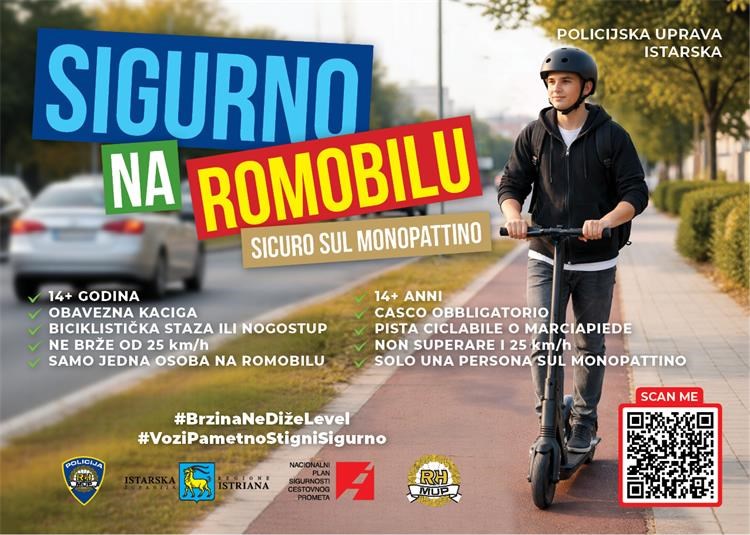
Električnim romobilom može upravljati samo osoba koja je navršila 14 godina.
Na električnom romobilu ne može se prevoziti više osoba, već samo osoba koja upravlja električnim romobilom.
Vozač električnog romobila mora voziti tako da se ne umanjuje stabilnost vozila i ne ometaju drugi sudionici u prometu, a osobito ne smije skidati istodobno obje ruke s upravljača, pridržavati se za drugo vozilo, prevoziti, vući ili gurati predmete koji ga mogu ometati u upravljanju vozilom ili ugrožavati druge sudionike u prometu.
Je li kaciga obavezna?
Vozači romobila, bez obzira na godine starosti, na glavi moraju nositi zaštitnu kacigu za vrijeme vožnje.
Po kojim površinama se vozači električnih romobila mogu kretati?
Vozač električnog romobila dužan se kretati biciklističkom stazom ili trakom, a u slučajevima kada biciklistička staza ili traka ne postoji, tada se treba kretati nogostupom, odnosno površinama namijenjenim za kretanje pješaka te zonama smirenog prometa.
Vozač romobila prilikom kretanja na nogostupu i pješačkim zonama mora voditi računa o sigurnosti pješaka, smanjiti brzinu kretanja prilikom nailaska na pješake te zvučnim znakom koji je obavezan uređaj na romobilu prethodno upozoriti pješake na svoj nailazak.
Kretanje električnim romobilom trenutno nije dopušteno po kolniku. Zakon o sigurnosti prometa na cestama predviđa mogućnost kretanja električnih romobila po kolniku, isključivo na onim dionicama cesta gdje je to propisano prometnim znakom, no trenutno niti jedna cesta u Hrvatskoj nije obilježena takvim prometnim znakom, što znači da kretanje električnim romobilom po kolniku nije dopušteno.
Kako prijeći cestu kada ima biciklističke staze, a kako kada je nema?
Ako se kreće biciklističkom stazom, vozač električnog romobila prilikom prelaska ceste dužan je obratiti pažnju na udaljenost i brzinu vozila koja mu se približavaju te kolnik prelaziti nakon što se uvjeri da to može učiniti na siguran način.
Ako biciklistička staza nije označena preko kolnika, vozač električnog romobila dužan je zaustaviti romobil i gurati ga preko obilježenog pješačkog prijelaza ili kolnika ceste.
Mogu li slušalice i vožnja zajedno?
Vozač električnog romobila ne smije imati slušalice u ili na oba uha jer se time umanjuje mogućnost reagiranja i sigurnog upravljanja vozilom.
Smije li vozač upravljati električnim romobilom ako je konzumirao alkohol?
Vozač osobnog prijevoznog sredstva ne smije upravljati vozilom ako u organizmu ima alkohola iznad 0.50 promila.
Koja je razlika između dnevne i noćne vožnje?
Na električnom romobilu od prvog sumraka do potpunog svanuća (noću), a i danju u slučaju smanjene vidljivosti, mora biti upaljeno svjetlo (na prednjoj strani bijele boje, a na stražnjoj strani crvene boje).
Vozač električnog romobila tijekom noći, a i danju u slučaju smanjene vidljivosti, mora biti označen reflektirajućim prslukom ili reflektirajućom odjećom ili drugom reflektirajućom oznakom.
Kamo s električnim romobilom?
Vozač električnog romobila ne smije ostaviti romobil bez nadzora na prometnim površinama za kretanje vozila i pješaka, osim na za to posebno uređenim i označenim mjestima.
Postoji li odgovornost roditelja ili druge osobe koja nadzire dijete koje počini prekršaj te vlasnika električnog romobila?
Ako prekršaj počini dijete mlađe od 14 godina, za počinjeni prekršaj kaznit će se roditelj ili druga osoba koja nadzire dijete ako je taj prekršaj u izravnoj vezi s propuštenim nadzorom roditelja ili druge osobe koja je trebala nadzirati dijete.
Vlasnik električnog romobila, odnosno osoba kojoj je električni romobil povjeren, ne smije dati romobil na upravljanje osobi za koju je mogao ili morao znati da nema pravo upravljati vozilom i osobi za koju se na temelju njezina ponašanja može zaključiti da je pod utjecajem droga ili lijekova ili koja u krvi ima nedozvoljenu količinu alkohola ili je pod vidnim utjecajem alkohola ili je u tolikoj mjeri umorna ili bolesna da nije u stanju na siguran način upravljati električnim romobilom.
Koje su kazne propisane za nepoštivanje prometnih pravila?
- Nenošenje kacige: 30 €
- Vožnja bez ''ruku'': 30 €
- Nepropisno korištenje slušalica tijekom vožnje: 30 €
- Vožnja pod utjecajem alkohola: 60 €
- Nepropisno kretanje električnim romobilom (kolnikom, dvije ili više osoba na romobilu): 60 €
- Neupaljena svjetla noću ili danju u slučaju smanjenje vidljivosti: 60 €
- Vožnja nekategoriziranim vozilom (romobilom veće jačine od propisane): 130 €
- Ostavljanje električnog romobila bez nadzora: 130 €
- Nepropisno prelaženje kolnika: 130 €
 SICURO SUL MONOPATTINO
Quali monopattini elettrici possono circolare nel traffico?
I monopattini elettrici rientrano nei veicoli personali ai sensi della Legge sulla sicurezza stradale. Si tratta di un veicolo privo di sedile, la cui cilindrata del motore non supera i 25 cm³ oppure la cui potenza continua del motore elettrico non è superiore a 0,6 kW e che su strada pianeggiante non può raggiungere una velocità superiore a 25 km/h.
I monopattini con potenza del motore superiore a quella prescritta e che raggiungono velocità superiori a 25 km/h non possono circolare nel traffico, e facciamo appello ai genitori affinché al momento dell'acquisto verifichino le specifiche del monopattino, in modo che il loro figlio possa guidare un monopattino legalmente conforme. I monopattini più potenti di quelli prescritti possono essere confiscati dalla polizia nel procedimento per infrazione.
Chi può guidare un monopattino elettrico?
Il monopattino elettrico può essere guidato solo da una persona che abbia compiuto 14 anni.
Sul monopattino elettrico non possono essere trasportate più persone, ma solo la persona che guida il monopattino elettrico.
Il conducente del monopattino elettrico deve guidare in modo da non ridurre la stabilità del veicolo e da non ostacolare gli altri utenti della strada; in particolare non deve togliere contemporaneamente entrambe le mani dal manubrio, aggrapparsi a un altro veicolo, trasportare, trainare o spingere oggetti che possano ostacolarlo nella guida del veicolo o mettere in pericolo gli altri utenti della strada.
Il casco è obbligatorio?
I conducenti di monopattini, indipendentemente dall'età, devono indossare un casco protettivo in testa durante la guida.
Su quali superfici possono circolare i conducenti di monopattini elettrici?
Il conducente del monopattino elettrico è tenuto a circolare sulla pista o corsia ciclabile e, nei casi in cui la pista o corsia ciclabile non esista, deve circolare sul marciapiede, ovvero sulle superfici destinate alla circolazione dei pedoni e nelle zone a traffico moderato.
Il conducente del monopattino, durante la circolazione sui marciapiedi e nelle zone pedonali, deve tenere conto della sicurezza dei pedoni, ridurre la velocità di marcia all'avvicinarsi dei pedoni e, con il segnale acustico, che è un dispositivo obbligatorio sul monopattino, avvertire preventivamente i pedoni del proprio avvicinarsi.
La circolazione con il monopattino elettrico non è attualmente consentita sulla carreggiata. La Legge sulla sicurezza stradale prevede la possibilità di circolazione dei monopattini elettrici sulla carreggiata, esclusivamente nei tratti stradali dove ciò è prescritto da apposita segnaletica, ma attualmente nessuna strada in Croazia è contrassegnata da tale segnaletica, il che significa che la circolazione con il monopattino elettrico sulla carreggiata non è consentita.
Come attraversare la strada quando è presente una pista ciclabile e quando non lo è?
Se si circola sulla pista ciclabile, il conducente del monopattino elettrico durante l'attraversamento della strada è tenuto a prestare attenzione alla distanza e alla velocità dei veicoli che gli si avvicinano e ad attraversare la carreggiata dopo essersi assicurato di poterlo fare in modo sicuro.
Se la pista ciclabile non è segnalata attraverso la carreggiata, il conducente del monopattino elettrico è tenuto a fermare il monopattino e a condurlo a mano attraverso l'attraversamento pedonale segnalato o della carreggiata.
Gli auricolari e la guida possono coesistere?
Il conducente del monopattino elettrico non può avere auricolari in o su entrambe le orecchie, in quanto ciò riduce la possibilità di reazione e di guida sicura del veicolo.
Il conducente può guidare il monopattino elettrico dopo aver consumato alcol?
Il conducente di un veicolo personale non può essere alla guida del veicolo se nell'organismo ha un tasso alcolico superiore a 0,50 promille.
Qual è la differenza tra la guida diurna e quella notturna?
Sul monopattino elettrico, dal primo crepuscolo fino all'alba completa (di notte), e anche di giorno in caso di visibilità ridotta, deve essere accesa la luce (bianca sul lato anteriore e rossa sul lato posteriore).
Il conducente del monopattino elettrico durante la notte, e anche di giorno in caso di visibilità ridotta, deve essere contrassegnato con un giubbotto retroriflettente o con indumenti retroriflettenti o altro segno retroriflettente.
Dove parcheggiare il monopattino elettrico?
Il conducente del monopattino elettrico non può lasciare il monopattino incustodito sulle superfici stradali destinate alla circolazione di veicoli e pedoni, ad eccezione dei luoghi appositamente attrezzati e segnalati.
Esiste responsabilità dei genitori o di un'altra persona che sorveglia un minore che commette un'infrazione come proprietario del monopattino elettrico?
Se l'infrazione è commessa da un minore di 14 anni, per l'infrazione commessa sarà sanzionato il genitore o un'altra persona che sorveglia il minore, se tale infrazione è direttamente correlata alla negligenza nella supervisione da parte del genitore o dell'altra persona che avrebbe dovuto sorvegliare il minore.
Il proprietario del monopattino elettrico, ovvero la persona a cui è stato affidato il monopattino elettrico, non può affidare il monopattino a una persona della quale sapeva o avrebbe dovuto sapere che non ha il diritto di guidare il veicolo, né a una persona del cui comportamento si possa dedurre che è sotto l'effetto di droghe o farmaci o che ha nel sangue una quantità di alcol non consentita o che è visibilmente sotto l'effetto dell'alcol o che è così stanca o malata da non essere in grado di guidare il monopattino elettrico in modo sicuro.
Quali sono le sanzioni previste per la violazione del codice della strada?
- Mancato uso del casco: 30 €
- Guida senza "mani": 30 €
- Uso improprio degli auricolari durante la guida: 30 €
- Guida in stato di ebbrezza: 60 €
- Circolazione impropria con il monopattino elettrico (sulla carreggiata, due o più persone sul monopattino): 60 €
- Luci spente di notte o di giorno in caso di visibilità ridotta: 60 €
- Guida di un veicolo non omologato (monopattino di potenza superiore a quella prescritta): 130 €
- Abbandono del monopattino elettrico incustodito: 130 €
- Attraversamento improprio della carreggiata: 130 €
 SAFETY TIPS FOR ELECTRIC SCOOTER RIDERS
Which electric scooters are allowed in traffic?
In accordance with the Road Traffic Safety Act, electric scooters fall under the category of personal transport devices. These are vehicles with no seat, an engine capacity not exceeding 25 cm3, or a maximum continuous rated power output of 0.6 kW, which cannot reach a speed greater than 25 km/h on a flat, straight road.
Scooters with a power output exceeding the prescribed limit or a maximum speed exceeding 25 km/h must not be operated in traffic. We urge parents to check the scooter’s specifications before purchase to ensure that their child can ride a legally compliant scooter. Scooters that exceed the prescribed limits can be confiscated by the police in administrative proceedings.
Who can ride an electric scooter?
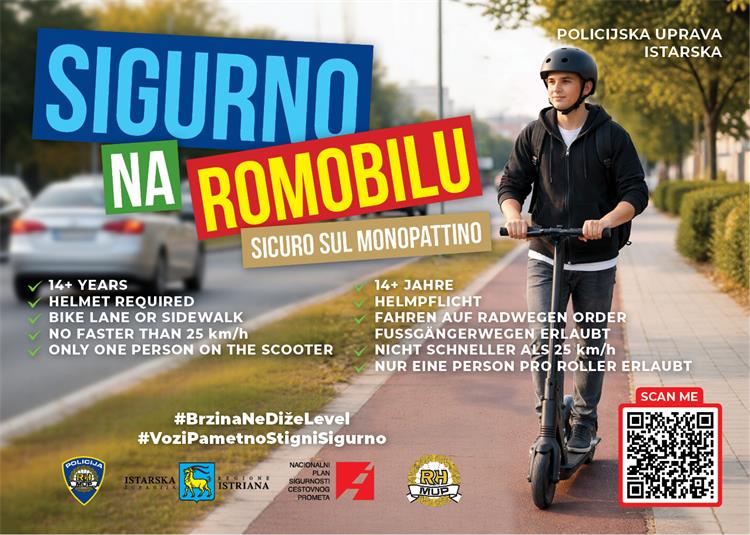
Electric scooters can only be operated by persons aged 14 or over.
Electric scooters cannot be used to carry more than one person. Only the person operating the scooter can ride it.
The person operating an electric scooter must ride in a manner that does not reduce the vehicle’s stability or impede other road users. In particular, they must not remove both hands from the handlebars at the same time, hold onto another vehicle, or carry, tow or push objects that may impede the control of the vehicle or endanger other road users.
Is it obligatory to wear a helmet?
All electric scooter riders, regardless of their age, must wear a protective helmet when riding.
Where are electric scooters allowed to operate?
Electric scooter riders are required to use a designated cycle track or lane. If there is no cycle track or lane, they must use the pavement or other areas designated for pedestrian use, as well as traffic-calming zones.
When riding on pavements and in pedestrian areas, electric scooter riders must ensure the safety of pedestrians, reduce speed when approaching them, and use an audible warning device (which is part of mandatory equipment) to alert pedestrians of their presence.
It is currently not permitted to use electric scooters on roads. Pursuant to the Road Traffic Safety Act, electric scooters can be used on roads, but only where this is indicated by a traffic sign. However, there are currently no roads in Croatia marked with such a sign, which means that electric scooters are not permitted on roads.
How do you cross the road when there is a cycle track, and how when there is none?
When riding in a cycle track and wishing to cross the road, electric scooter riders must pay attention to the distance and speed of approaching vehicles, and they may cross the road only after making sure it is safe to do so.
If there is no cycle track marked across the road, electric scooter riders must dismount and walk their scooter across a marked pedestrian crossing or across the road.
Can you ride with your headphones on?
Electric scooter riders must not wear headphones in or on both ears, as this reduces their ability to react and ride safely.
Can you ride an electric scooter after consuming alcohol?
You must not ride a personal transport device if your blood alcohol level is over 0.5 g/L.
What is the difference between daytime and night-time riding?
Electric scooters must have their lights (a white front light and a red rear light) switched on from dusk until dawn (at night) and also during the day in conditions of reduced visibility.
Electric scooter riders must wear a reflective vest or reflective clothing, or be marked with other reflective markings at night, as well as during the day in conditions of reduced visibility.
Where can you park an electric scooter?
Electric scooter riders must not leave their scooters unattended in areas of vehicle and pedestrian traffic, except in designated and marked areas.
Can parents, those responsible for supervising a child, or owners of electric scooters be held responsible if a child commits an offence?
If an offence is committed by a child under the age of 14, the parent or other person responsible for supervising the child will be sanctioned, provided that the offence is directly connected to their lack of proper supervision.
The owner or the person entrusted with an electric scooter must not allow anyone to ride it if they know or should reasonably be expected to know that the person is not legally permitted to operate the vehicle, or if the person appears to be under the influence of drugs or medication, has an illegal blood alcohol level, is visibly intoxicated, or is too tired or unwell to ride the electric scooter safely.
What are the fines for violating traffic rules?
- Failure to wear a helmet: € 30
- Riding hands-free: € 30
- Improper use of headphones while riding: € 30
- Riding under the influence of alcohol: € 60
- Improper use of an electric scooter (riding on roads, carrying more than one person): € 60
- Riding without lights at night or during the day in conditions of reduced visibility: € 60
- Riding an unclassified electric scooter (exceeding the allowed power): € 130
- Leaving an electric scooter unattended: € 130
- Crossing the road improperly: € 130
 SICHERHEITSTIPPS FÜR E-SCOOTER-FAHRER
Welche E-Scooter dürfen am Verkehr teilnehmen?
Gemäß dem kroatischen Gesetz über die Sicherheit im Straßenverkehr gehören E-Scooter in die Sonderkategorie der individuellen Verkehrsmittel. Dabei handelt es sich um Verkehrsmittel ohne Sitz, die eine größte Dauerleistung von maximal 0,6 kW oder einen Hubraum von maximal 25 cm³ haben und auf einer geraden Straße eine Höchstgeschwindigkeit von maximal 25 km/h erreichen können.
E-Scooter, die den vorgeschriebenen Grenzwert für die Motorleistung überschreiten oder eine Höchstgeschwindigkeit von mehr als 25 km/h erreichen, dürfen nicht in den Verkehr gebracht werden. Wir appellieren an die Eltern, vor dem Kauf die technischen Daten des E-Scooters zu überprüfen, um sicherzustellen, dass ihr Kind einen gesetzeskonformen E-Scooter fährt. E-Scooter, die die vorgeschriebenen Grenzwerte überschreiten, können von der Polizei im Rahmen eines Ordnungswidrigkeitenverfahrens beschlagnahmt werden.
Wer darf einen E-Scooter fahren?
Zum Führen eines E-Scooters sind nur Personen berechtigt, die das 14. Lebensjahr vollendet haben.
Der E-Scooter ist nur für die Beförderung einer Person zugelassen, und zwar ausschließlich der Person, die den E-Scooter führt.
E-Scooter-Fahrer müssen so fahren, dass die Stabilität des Fahrzeugs nicht beeinträchtigt wird und keine anderen Verkehrsteilnehmer gestört werden. Sie dürfen insbesondere nicht beide Hände gleichzeitig vom Lenker nehmen, sich an einem anderen Fahrzeug festhalten oder Gegenstände transportieren, ziehen oder schieben, durch die sie die Kontrolle über das Fahrzeug verlieren oder andere Verkehrsteilnehmer gefährden könnten.
Gibt es eine Helmpflicht?
Alle E-Scooter-Fahrer müssen während der Fahrt einen Schutzhelm tragen, unabhängig von ihrem Alter.
Wo dürfen E-Scooter gefahren werden?
E-Scooter-Fahrer müssen den Radweg oder den Radfahrstreifen benutzen. Wenn weder Radweg noch Radfahrstreifen vorhanden sind, müssen sie den Gehweg benutzen, das heißt Flächen, die für Fußgänger vorgesehen sind, und verkehrsberuhigte Zonen..
E-Scooter-Fahrer müssen bei der Fahrt auf dem Gehweg oder in Fußgängerzonen auf die Sicherheit der Fußgänger achten. Sie müssen ihre Geschwindigkeit bei einer Begegnung mit Fußgängern reduzieren und diese durch die vorgeschriebene Klingel vorher warnen.
Aktuell ist das Fahren mit dem E-Scooter auf der Fahrbahn nicht erlaubt. Gemäß dem Gesetz über die Sicherheit im Straßenverkehr ist das Fahren von E-Scootern auf der Fahrbahn nur auf entsprechenden Fahrbahnabschnitten zulässig, die durch ein entsprechendes Verkehrszeichen gekennzeichnet sind. Derzeit ist jedoch keine Straße in Kroatien mit einem solchen Verkehrszeichen gekennzeichnet. Das bedeutet, dass das Fahren mit dem E-Scooter auf der Fahrbahn nicht erlaubt ist.
Wie dürfen E-Scooter-Fahrer die Straße überqueren, wenn es einen Radweg gibt, und wie, wenn es keinen gibt?
Beim Überqueren der Straße auf dem Radweg muss der E-Scooter-Fahrer, auf den Abstand und die Geschwindigkeit der sich nähernden Fahrzeuge achten. Er darf die Straße erst überqueren, wenn er sich sicher ist, dass er dies gefahrlos tun kann.
Wenn kein Radweg über die Fahrbahn markiert ist, muss der E-Scooter-Fahrer anhalten und den E-Scooter über den markierten Fußgängerüberweg oder die Fahrbahn schieben.
Dürfen Fahrer mit Kopfhörern den E-Scooter fahren?
E-Scooter-Fahrer dürfen keine Kopfhörer in oder an beiden Ohren tragen, da dies ihre Reaktionsfähigkeit und Fahrsicherheit beeinträchtigt.
Dürfen Fahrer den E-Scooter unter Alkoholeinfluss fahren?
Einem Fahrer eines individuellen Verkehrsmittels ist es nicht gestattet, es zu führen, wenn er einen Alkoholwert von mehr als 0,50 Promille aufweist.
Gibt es Unterschiede bei Tages- und Nachtfahrten?
Auf dem E-Scooter muss das Licht von der ersten Dämmerung bis zum Morgengrauen (nachts) und tagsüber bei eingeschränkter Sicht eingeschaltet sein (weißes Vorder- und rotes Rücklicht).
E-Scooter-Fahrer müssen nachts sowie tagsüber bei eingeschränkter Sicht entweder eine reflektierende Warnweste oder reflektierende Kleidung tragen. Alternativ können sie auch mit anderen reflektierenden Markierungen gekennzeichnet sein.
Wo darf man E-Scooter abstellen?
E-Scooter-Fahrer dürfen ihren E-Scooter nicht unbeaufsichtigt auf Verkehrsflächen für Fahrzeuge und Fußgänger zurücklassen, es sei denn, es handelt sich um speziell dafür vorgesehene und gekennzeichnete Orte.
Können Eltern, eine andere für die Beaufsichtigung des Kindes verantwortliche Person oder der Besitzer des E-Scooters zur Verantwortung gezogen werden, wenn ein Kind eine Ordnungswidrigkeit begeht?
Wird eine Ordnungswidrigkeit von einem Kind unter 14 Jahren begangen, wird der Elternteil oder eine andere für die Beaufsichtigung des Kindes verantwortliche Person bestraft, sofern die Ordnungswidrigkeit direkt auf ihre mangelnde Aufsicht zurückzuführen ist.
Der Eigentümer oder die mit einem E-Scooter betraute Person darf niemandem die Benutzung des E-Scooters gestatten, wenn ihm bekannt ist oder er hätte wissen müssen, dass die Person nicht gesetzlich zum Führen des E-Scooters berechtigt ist. Das Gleiche gilt, wenn die Person unter dem Einfluss von Drogen oder Medikamenten zu stehen scheint, einen unzulässigen Blutalkoholwert hat, sichtbar betrunken ist, zu müde ist oder sich zu unwohl fühlt, um den E-Scooter sicher zu fahren.
Welche Geldbußen werden bei Verstößen gegen die Verkehrsregeln verhängt?
- Nichttragen eines Schutzhelms: 30 €
- Freihändiges Fahren: 30 €
- Vorschriftswidrige Benutzung von Kopfhörern während der Fahrt: 30 €
- Fahren unter Alkoholeinfluss: 60 €
- Vorschriftswidrige Benutzung des E-Scooters (Befahren der Fahrbahn, Mitfahren mehrerer Personen auf einem E-Scooter): 60 €
- Nicht eingeschaltete Lichter bei Nacht oder bei eingeschränkter Sicht am Tag: 60 €
- Fahrt mit einem nicht klassifizierten Fahrzeug (E-Scooter, die die vorgeschriebenen Grenzwerte überschreiten): 130 €
- Abstellen eines E-Scooters ohne Aufsicht: 130 €
- Vorschriftswidrige Überquerung der Fahrbahn: 130 €